

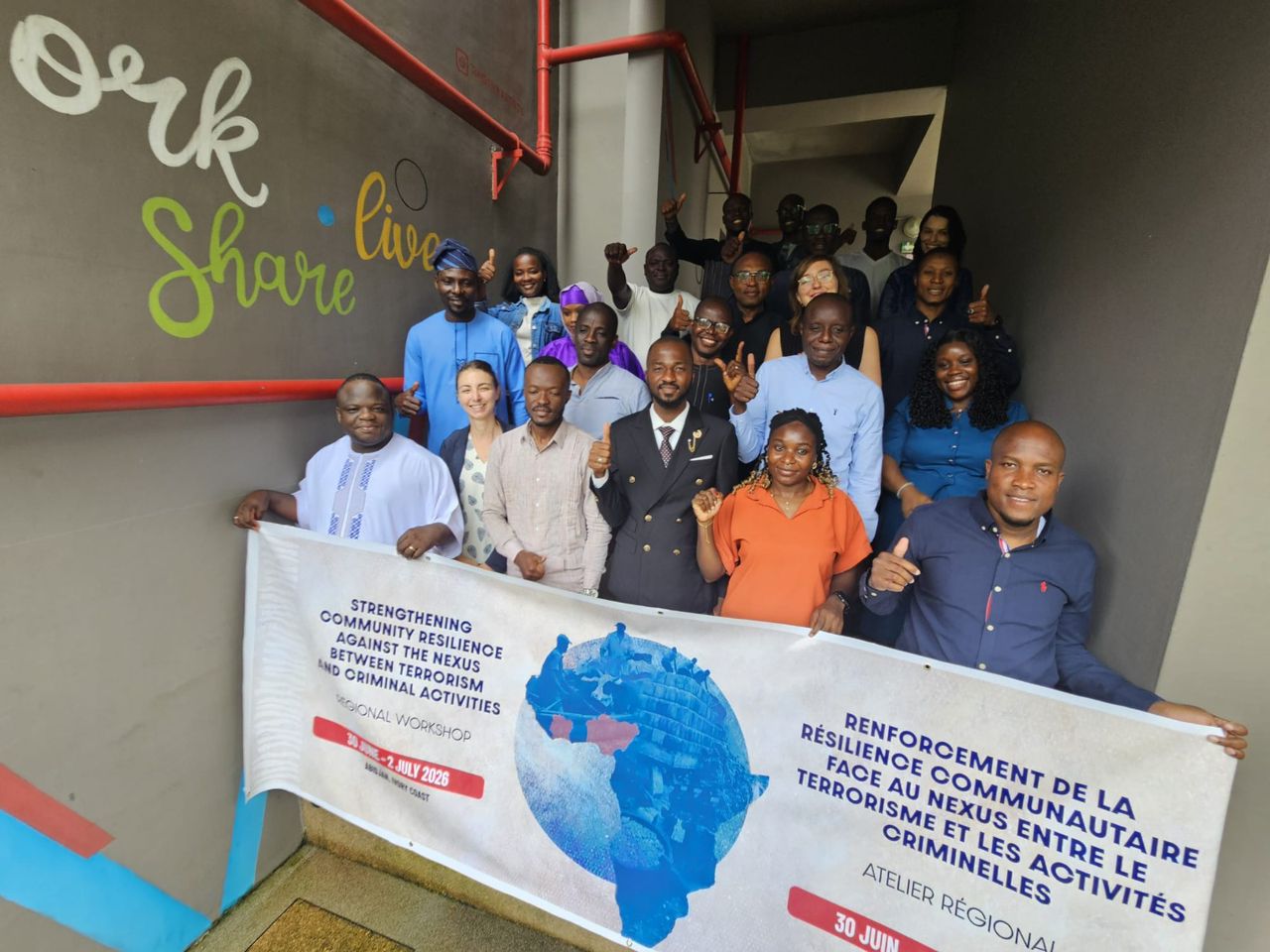
The Climate and Sustainable Development Network (CSDevNet) participated in a three-day regional workshop on “Strengthening Community Resilience Against the Nexus Between Terrorism and Criminal Activities”, held from 30 June to 2 July 2026 in Abidjan, Côte d’Ivoire. The workshop brought together researchers, practitioners, policymakers, and civil society organizations from across West Africa to explore practical approaches for preventing and addressing the growing links between terrorism and criminal activities at the community level.
The workshop was organized within the framework of the United Nations Interregional Crime and Justice Research Institute (UNICRI) project, “Assessing and Addressing the Nexus between Organized Crime and Terrorism in Africa.” It builds on recent research, including the UNICRI report, Dangerous Liaisons: Assessing the Nexus Between Terrorism and Criminal Activities in Africa, and seeks to translate evidence-based findings into practical, context-sensitive prevention strategies.
Designed as an interactive platform, the workshop enabled participants to move beyond analytical discussions toward actionable solutions that can strengthen resilience in vulnerable communities affected by insecurity, illicit economies, and violent extremism.
The workshop aimed to strengthen participants’ understanding of how the nexus between terrorism and criminal activities manifests across different contexts, facilitate collective interpretation of research findings, identify key local drivers of these interactions, and explore context-specific prevention and resilience-building opportunities.
Participants examined factors such as governance gaps, political economy dynamics, weak institutional presence, and social legitimacy challenges that often create environments where criminal markets and terrorist groups can thrive. The workshop also sought to support the development of practical strategies and actions for implementation at both local and national levels.
Elena Dal Santo, the Programme Management Officer, United Nations Interregional Crime and Justice Research Institute (UNICRI), emphasized the importance of adopting a broader analytical perspective when examining the relationship between terrorism and criminal activities. She explained that recent research has moved beyond focusing solely on organized criminal groups to examining the wider ecosystem of criminal markets and the various actors that operate within them.
“We have reconceptualized the unit of analysis from organized criminal groups to the broader configuration of criminal markets,” Elena Dal Santo UNICRI Programme Management Officer noted.
The first day focused on understanding the evolving relationship between terrorism and criminal activities. Participants engaged with findings from UNICRI and partner organizations, using a continuum framework that examined stages of interaction including coexistence, cooperation, competition, and convergence between terrorist actors and criminal economies. The sessions enabled participants to identify patterns, trends, and drivers shaping these relationships across different regions of Africa, culminating in a synthesis of key analytical insights.
The second day shifted attention to practical experiences and lessons learned from community-based prevention initiatives. Through peer exchanges and case studies, participants discussed effective approaches in communication, advocacy, and community engagement. Special attention was given to managing risks associated with prevention efforts, including stigma, mistrust, exclusion, and unintended harm. Participants highlighted the importance of locally led interventions that address root causes of vulnerability while strengthening trust between communities and institutions.
The final day focused on action planning and collaborative problem-solving. Participants presented group work on transferable prevention approaches and engaged in plenary discussions on how national and international stakeholders can better support community resilience efforts.
The workshop concluded with concrete recommendations and action plans that took into account local governance realities, power relations, and political economy constraints affecting implementation.
Speaking during the workshop, CSDevNet National Network Coordinator, Mr. Steve Abu, shared practical experiences from the organization’s prevention and resilience-building initiatives implemented across Adamawa, Borno, and Yobe States in North-East Nigeria.
He highlighted community-centered approaches that combine livelihood support, social cohesion, and prevention of violent extremism interventions. According to him, creating sustainable economic opportunities for vulnerable populations remains one of the most effective pathways for reducing susceptibility to recruitment by criminal and extremist groups.
Mr. Steve Abu emphasized the need to scale up livelihood opportunities for vulnerable groups and community members, enabling them to become productive contributors to their communities rather than remaining exposed to economic vulnerabilities that can be exploited by criminal and terrorist networks.
He further called for a national dialogue involving government institutions, civil society organizations, development partners, and regional actors to collectively address the underlying drivers of insecurity. He also advocated for stronger cross-border initiatives to tackle the transnational nature of criminal markets and terrorist activities.
“A society devoid of banditry and terrorism is achievable when people have improved livelihoods and equal economic opportunities,” Steve Abu stated during the discussions.
Key Recommendations and Action Points
The workshop generated several practical recommendations aimed at strengthening community resilience and addressing the nexus between terrorism and criminal activities across the region.
Key action points include:
- Working closely with local Community-Based Organizations (CBOs), Civil Society Organizations (CSOs), and women-led groups to provide psychosocial support and strengthen first-responder capacities in at-risk communities across northern regions.
- Expanding vocational skills development and entrepreneurship opportunities for women and young people, with sustainable financing models that enable beneficiaries to become owners and drivers of their own economic initiatives.
- Influencing national and regional policies on terrorism prevention to ensure that community-driven prevention models are recognized, adequately funded, and replicated across Nigeria and West Africa.
- Promoting stronger cross-border collaboration and information-sharing among countries including Nigeria, Benin, and Côte d’Ivoire to address transnational criminal and terrorist networks.
- Strengthening community capacities to identify, prevent, report, and combat illicit activities linked to terrorism and organized crime.
- Fostering trust, cooperation, and sustained collaboration between communities, security agencies, and government institutions in designing and implementing locally driven prevention approaches.
For CSDevNet, the workshop provided an important opportunity to share field-based experiences, learn from regional partners, and contribute to the development of practical strategies that strengthen resilience across vulnerable communities. The organization remains committed to advancing community-led approaches that promote peace, security, sustainable livelihoods, and long-term development across Nigeria and the wider West African region.