

Written by: Mariam Idris
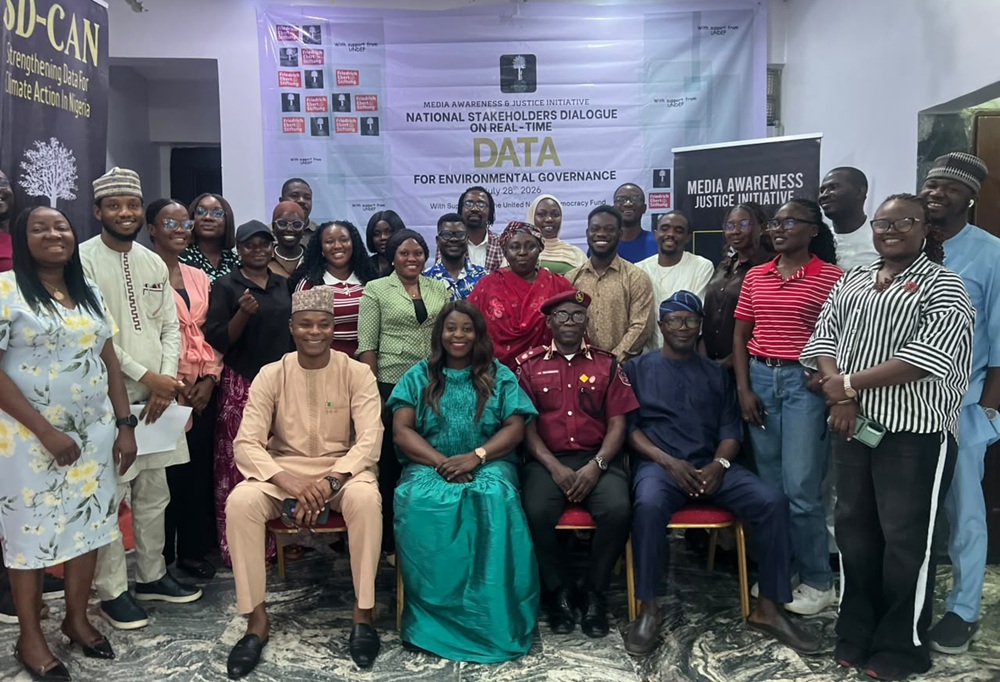
The Climate and Sustainable Development Network of Nigeria (CSDevNet) joined the Media Awareness and Justice Initiative (MAJI), with support from the United Nations Democracy Fund (UNDEF) and in collaboration with Friedrich-Ebert Stiftung (FES), at a one-day high-level meeting on “Strengthening Data for Climate Action in Nigeria.” The meeting served as a strategic platform for advancing discussions on the role of evidence-based environmental data in improving climate governance, environmental accountability, and public participation in Nigeria.
The event brought together representatives from the National Oil Spill Detection and Response Agency (NOSDRA), the National Environmental Standards and Regulations Enforcement Agency (NESREA), the Federal Ministry of Environment, the Department of Climate Change, the Nigerian Climate Change Council (NCCC), civil society organizations, research institutions, and media organizations working on environmental governance and climate change, with a particular focus on air quality. Through interactive discussions, participants examined the importance of real-time environmental data in monitoring pollution, strengthening regulatory compliance, and supporting informed decision-making. MAJI also demonstrated innovative digital tools for environmental monitoring, including its DATACAB online air-quality portal, showcasing how technology can improve data collection, analysis, reporting, and public access to environmental information.
Speaking during the meeting, the Executive Director of MAJI, Oyekachi Okoro Emmanuel, welcomed participants and emphasized the importance of collaborative engagement in shaping environmental policies and actions. He noted that the dialogue was designed to explore the relationship between media narratives, identity, and environmental governance while highlighting the growing need for reliable, real-time environmental data to support advocacy and policymaking. “We are an organization based in Delta State working to promote environmental justice and sustainable development. This conversation centers on media, identity, and the need for real-time data in our work.
I encourage everyone to contribute their perspectives, as your input is invaluable. Together, we will also explore the role of air-quality monitoring devices in generating the evidence needed to drive meaningful environmental action,” he said.
Discussions throughout the meeting further highlighted the close intersection between environmental sustainability, social justice, and governance. Participants observed that environmental degradation often has the greatest impact on vulnerable and marginalized communities, making environmental protection not only an ecological priority but also a human rights and development imperative. They stressed that strengthening environmental governance requires inclusive policies that address inequality while ensuring that citizens have access to accurate environmental information capable of informing both public action and government response.
The dialogue concluded with a shared commitment to strengthening environmental governance through evidence-based policymaking. Participants identified key priorities, including the enforcement of stronger environmental regulations, increased investment in air-quality monitoring technologies, improved public access to environmental data, and deeper collaboration among government agencies, civil society organizations, media institutions, researchers, and local communities. They emphasized that such partnerships are essential for promoting transparency, accountability, and environmental justice while enhancing Nigeria’s capacity to respond effectively to climate and environmental challenges.
The overarching objective of the initiative is to foster meaningful citizen and stakeholder participation in environmental monitoring, reporting, and engagement by leveraging credible, evidence-based data. Participants agreed that expanding access to accurate environmental information will strengthen advocacy efforts, enable policymakers and regulatory institutions to identify targeted interventions, and support the development of informed policies that address Nigeria’s evolving environmental and climate priorities.
As an organization championing climate action and environmental sustainability, CSDevNet reaffirmed its commitment to promoting collaborative approaches that strengthen environmental governance across Nigeria. The organization called for stronger partnerships among government institutions, civil society organizations, research institutions, development partners, and the media to scale up real-time environmental data collection and monitoring systems. CSDevNet emphasized that expanding the use of air-quality monitoring technologies and other data-driven innovations will improve access to reliable environmental information, enhance evidence-based decision-making, strengthen environmental regulation, and contribute to healthier, more resilient, and climate-resilient communities across the country.