Written by: Mariam Idris
The Climate and Sustainable Development Network of Nigeria (CSDevNet) has strengthened the capacity of grassroots organisations and civil society organisations (CSOs) to translate complex climate information into simple, practical, and locally relevant messages that communities can understand and act upon.
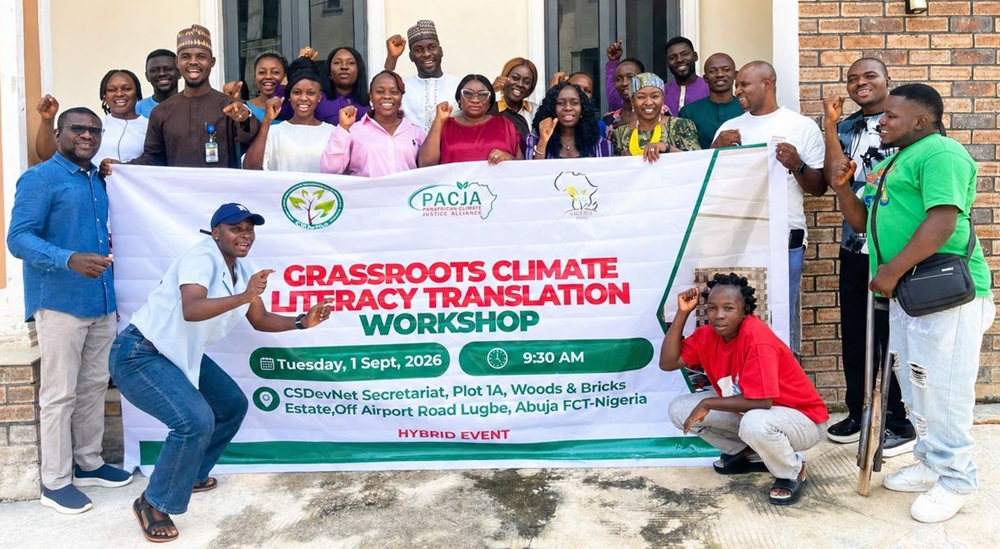
The capacity-building engagement took place during a Climate Literacy Translation Workshop held on Tuesday, September 1, 2026, at the CSDevNet Building, Plot 1A, Woods and Bricks Estate, Off Airport Road, Lugbe, FCT Abuja. The workshop brought together stakeholders to examine the information and communication needs of grassroots communities, farmers, and small and medium-sized enterprises (SMEs), while exploring approaches for improving access to and understanding of climate-related information.
Opening the workshop, Mr. Abuh Steve, National Network Coordinator (NNC), CSDevNet, emphasised the importance of strengthening climate literacy among local actors. He noted that effective climate action goes beyond developing policies and generating technical knowledge, stressing that communities must also be able to access, understand, and apply climate information in ways that respond to their everyday realities.
The opening session was followed by Session 1: Climate Finance and Climate Literacy Information Needs, facilitated by Mrs. Rifkatu Joseph, Founder, Eco-friendly Sensitisation and Advocacy.
Participants identified key information gaps and challenges affecting grassroots organisations, farmers, and SMEs, including limited access to relevant climate information, the use of complex technical terminology, and inadequate capacity to understand climate finance opportunities. The discussions underscored the need to make climate information more accessible and relevant to the people and communities who are directly affected by climate change.
Speaking during the session, Aliyu Sadiq, an Environmentalist and Researcher working across climate change, circular economy, and international development, highlighted the importance of understanding community perceptions when communicating climate issues. He noted that “the issue of pessimism within rural communities can sometimes make climate advocacy and awareness efforts difficult.” He called for communication approaches that recognise local experiences, address community concerns, and build trust while presenting climate action as an opportunity rather than an abstract or distant issue.
The workshop also provided a platform for community perspectives on the practical challenges associated with climate change and sustainable agriculture. Theresa Attaboh, a farmer, highlighted concerns affecting rural farming communities, particularly disease outbreaks and the use of chemical inputs in agriculture. She noted that “farmers are increasingly concerned about disease outbreaks and the use of chemicals in farming, raising questions about what the government can do to better support rural communities.” Her contribution reinforced the need for stronger government support, access to safer and more sustainable agricultural practices, and interventions that can protect farmers’ livelihoods and strengthen rural resilience.

A major highlight of the workshop was the Group Translation and Co-Design Exercise, facilitated by Mr. Joseph Paul, Programme Officer, CSDevNet. Participants worked in groups to transform technical climate concepts into simple, accurate, and actionable messages suitable for grassroots audiences. The exercise encouraged participants to consider local language, community realities, practical examples, and the information needs of different groups when developing climate communication materials.
The group outputs were subsequently presented during a Plenary Validation Session, where participants reviewed the messages, provided feedback, and identified priority recommendations. The process demonstrated the importance of involving local actors in the development of climate communication materials to ensure that information is both technically sound and understandable, relevant, and actionable at the community level.
Participants also explored climate mitigation and practical ways communities can contribute to reducing greenhouse gas emissions and enhancing natural carbon absorption. Proposed actions included tree planting, reducing bush burning, improving waste management, promoting recycling, and using animal manure as an alternative to chemical inputs where appropriate. Discussions emphasised that climate mitigation becomes easier to understand when it is linked to familiar activities and the direct benefits that communities can derive from sustainable practices.
Another key focus was the role of green jobs in promoting climate-resilient livelihoods. Participants explored opportunities in waste sorting, recycling, community clean-up initiatives, renewable energy, and other environmentally sustainable activities that can generate income while addressing environmental challenges. Particular attention was given to communities dependent on sectors such as coal mining and oil and gas, with participants stressing the need for climate communication to include realistic alternative livelihood opportunities as part of a just and inclusive transition.
The workshop concluded with a renewed commitment by CSDevNet and participating organisations to strengthen collaboration around climate literacy and community-level climate action. The outcomes will contribute to the development of a comprehensive Climate Adaptation and Mitigation Toolkit designed to support grassroots organisations, CSOs, and communities in communicating climate risks, opportunities, and practical responses.
The engagement reflects CSDevNet’s continued commitment to bridging the gap between technical climate knowledge and community understanding. By equipping local actors with the skills to translate complex climate information into clear and actionable messages, CSDevNet is contributing to a more informed, inclusive, and locally driven approach to climate action in Nigeria.